
.svg)


You are likely looking for the best Vietnamese iced coffee recipe (Cà Phê Sữa Đá), but most guides online get it wrong. They treat it like a regular cold brew or a sugary latte.
True Vietnamese coffee is a ritual of physics. Unlike paper filters (like V60 or Chemex) that trap essential oils, the traditional Phin filter (a stainless steel or aluminum drip tool) allows the natural lipids and bold flavors of the coffee bean to pass through. The result? A brew that is thick, syrupy, and intense; often described by travelers as "rocket fuel."
In this authentic Vietnamese iced coffee recipe, we ditch the generic advice. We are taking you into the lab to teach you the exact water temperature, grind size, and the secret "blooming technique" used by professional baristas in Local Beans Roastery.
What is Ca Phe Sua Da?
Literally translating to "Coffee, Milk, Ice," Cà Phê Sữa Đá is Vietnam's answer to the latte; but with double the intensity.
So, what makes a Vietnamese iced coffee recipe distinct from a regular iced latte?
-
The Bean: It uses high-caffeine Robusta beans (often grown in the Central Highlands of Vietnam).
-
The Roast: A slow, deep Dark Roast (often called "Butter Roast").
-
The Sweetener: Sweetened Condensed Milk, not fresh milk.
-
The Method: Gravity-driven drip coffee extraction.
Deep Dive: Why condensed milk? Why Robusta? Discover the fascinating 1857 origin story in our dedicated article: The Soul of Vietnam: History of Cà Phê Sữa Đá.

Ingredients for the Perfect Vietnamese Iced Coffee Recipe
To execute this Vietnamese iced coffee recipe perfectly, you must respect the chemistry of the ingredients. You cannot swap these out and expect the authentic flavor.
1. The Bean: Robusta (The Caffeine Powerhouse)
-
The Mistake: Using 100% Arabica beans.
-
The Science: Arabica is naturally acidic and fruity. When mixed with heavy condensed milk, it clashes, creating a sour taste.
-
The Fix: The soul of any great Vietnamese iced coffee recipe is Robusta. It has 2.7% caffeine content (nearly double that of Arabica) and bold notes of dark chocolate, popcorn, and whiskey.
-
Entity Insight (Butter Roast): Authentic Vietnamese beans (like Trung Nguyen) are often roasted with butter oil and a pinch of salt. This induces the Maillard reaction, creating a signature oily, chocolatey mouthfeel that plain beans cannot replicate.
-
Recommendations: Trung Nguyen (Sang Tao 1 or S), Nguyen Coffee Supply (Loyalty Blend), or Cafe Du Monde (chicory blend).
>>> Read more: Vietnamese Robusta Coffee
2. The Sweetener: Condensed Milk (Not Evaporated)
-
The Rule: A traditional cafe sua da recipe never uses fresh milk or evaporated milk.
-
The Why: Sweetened Condensed Milk has had water removed, increasing its viscosity. This creates the creamy texture essential for the drink.
-
Gold Standard: Longevity Brand (Sữa Ông Thọ) or Southern Star (Ngôi Sao Phương Nam).
.jpg)
>>> Read more: How to Make Vietnamese Coffee with Condensed Milk
3. The Ice: Surface Area Matters
-
Pro Tip: To master this Vietnamese iced coffee recipe, use crushed ice or small tubular ice. Large cubes melt too slowly. You want the ice to chill the coffee instantly to lock in the aroma.
.jpg)
Equipment – The Phin Filter
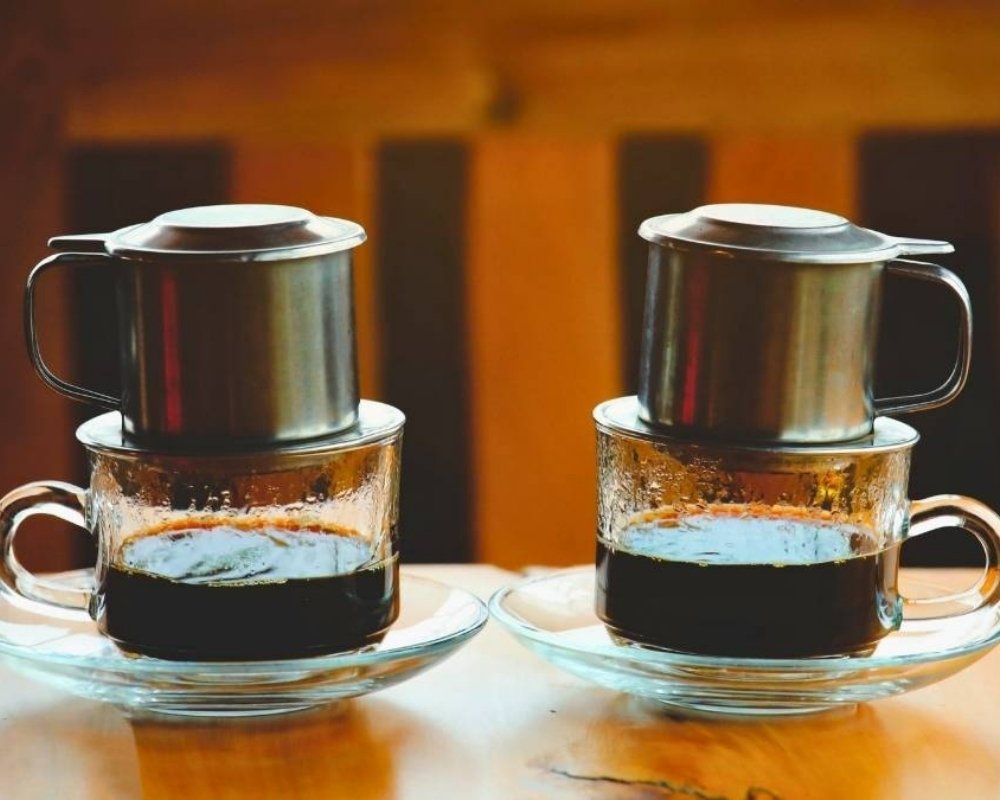
You cannot make this Vietnamese iced coffee recipe with a Keurig. You need a Phin filter. This tool is a gravity-driven extraction device, acting like a slow-motion espresso maker.
Anatomy of a Phin:
-
The Plate: Sits on the glass.
-
The Chamber: Holds the coffee grounds.
-
The Gravity Press (Damper): Controls drip rate.
-
The Lid: Retains heat.
Aluminum vs. Stainless Steel:
For the best Vietnamese coffee recipe, many experts prefer Aluminum. It has higher thermal conductivity, preventing "thermal shock" during the bloom phase.
.jpg)
>>> Read more: The Best Phin Filter 2025: Gravity vs. Screw-Down
Step-by-Step Vietnamese Iced Coffee Recipe
Here is the exact Barista Guide to making Ca Phe Sua Da at home.
-
Prep Time: 2 minutes
-
Brew Time: 5-6 minutes
-
Total Time: 8 minutes
-
Yield: 1 Serving
-
Calories: ~130 kcal
The Golden Ratio Calculator
| Ingredient | Metric | US Standard |
|---|---|---|
| Robusta Coffee | 20g – 25g | 3 tbsp (heaping) |
| Condensed Milk | 30 ml | 2 tbsp |
| Hot Water | 100 ml | ~3.5 oz |
| Water Temperature | 93°C – 96°C | 200°F – 205°F |
Instructions
Step 1: The Setup (Mise-en-place)
Pour 2 tbsp (30ml) of sweetened condensed milk into a clear highball glass.
-
Note: Using a clear glass allows you to see the beautiful separation of layers, a key aesthetic of this Vietnamese iced coffee recipe.
Step 2: The Preheat
Pour hot water through the empty Phin filter and discard it. This ensures your equipment is hot, vital for proper extraction.
Step 3: The Load & The "Tactile Tamp"
Add 3 tbsp (20g) of medium-coarse ground coffee (texture of sea salt) to the chamber. Shake gently to level.
Place the Gravity Press on top.
-
Barista Secret: Press down very gently. Unlike espresso tamping, this Vietnamese coffee recipe relies on gravity. If you press too hard, the water won't flow.
Step 4: The Bloom (The Secret Sauce)
This is the step generic "easy recipes" miss.
Pour just enough hot water (20ml) to cover the gravity press.
STOP. Wait 45 seconds.
-
The Science: You will see bubbles rising. This is degassing (CO2 escaping). If you skip this, water will "channel" through the dry gaps, resulting in a weak Vietnamese iced coffee recipe.
Step 5: The Extraction
Pour the remaining hot water (80ml) to the top. Cover with the lid.
Watch the drip. It should fall at a hypnotic pace: drop... drop... drop... (approx. 1 drop per second).
Step 6: The Whip
Once dripping stops, remove the Phin. Stir vigorously ("The Whip"). You want to cook the milk with the hot coffee to create a caramel-colored emulsion.
Step 7: The Serve
Pour the mixture over a glass full of crushed ice. Stir and wait 30 seconds for the "sweet spot" of dilution.
Troubleshooting Your Vietnamese Coffee
Even the best Vietnamese iced coffee recipe can go wrong if the technique is off. Use this matrix to fix it.
| Problem | Diagnosis | The Fix |
|---|---|---|
| Drips too fast (< 3 mins) | Under-extraction. Grind is too coarse. | Use a finer grind or add more coffee next time. |
| Drips too slow (> 8 mins) | Over-extraction. Grind is too fine (dusty). | Use a coarser grind or loosen the gravity press. |
| Taste is sour | Under-heated water. | Ensure water is 200°F+. Or you used Arabica beans instead of Robusta. |
| Taste is burnt | Water too hot. | Do not use boiling water (212°F). Let kettle sit for 30s. |
FAQ - Common Questions About This Recipe
Q: Can I use a French Press for this Vietnamese iced coffee recipe?
A: Yes. While it lacks the Phin's intensity, a French Press is the best alternative. Brew dark roast Robusta for 4 minutes, then pour over condensed milk.
Q: Is Vietnamese coffee stronger than espresso?
A: Yes. Vietnamese coffee beans (Robusta) carry nearly double the caffeine of Arabica. This Vietnamese iced coffee recipe creates a highly concentrated drink.
Q: Is there a Vegan Vietnamese iced coffee recipe?
A: Absolutely. Replace condensed milk with Sweetened Condensed Coconut Milk (e.g., Nature's Charm).
Conclusion: Master the Art of Slow Living
You now possess the ultimate Vietnamese iced coffee recipe. In a world of instant gratification, the Phin filter teaches us that the best things are worth waiting for.
Now that you have the technical knowledge, you are ready to brew.
>>> Read more: