
.svg)

What is Bac Xiu?
- Pronunciation: Bahk-See-you (Sounds a bit like "Back See You").
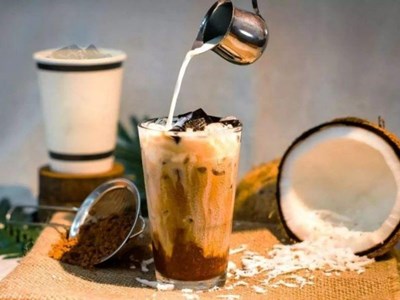
Unlike its world-famous cousin, Cà Phê Sữa Đá, which is a shot of strong coffee balanced with sweet milk, Bac Xiu flips the traditional ratio on its head. It’s a glass of milk (both condensed and fresh) "stained" with a small amount of coffee.
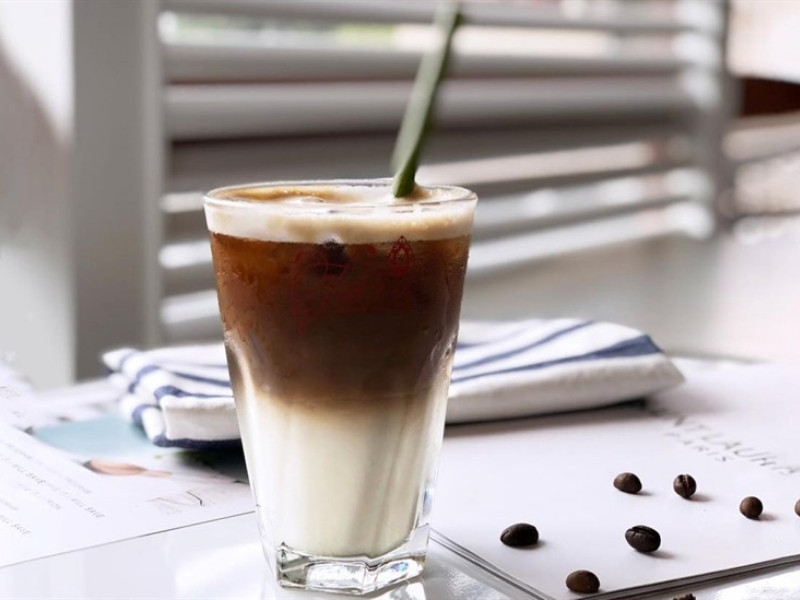
Visually, it is stunning. Served in a tall glass, it features distinct layers that tell you exactly what you are about to taste:
- A dense, creamy white layer at the bottom (condensed milk).
- Transitioning into a caramel-colored middle (fresh milk and ice).
- Topped with a frothy, dark coffee foam.
The name itself tells the whole story. It comes from the Cantonese phrase "Bạc Tẩy Xỉu Phé" (白仔小啡), which was popular in Saigon's Chinese community.
- Bạc (白): White / Milk
- Tẩy (仔): A glass or cup
- Xỉu (小): A little
- Phé (啡): Coffee
Put it all together, and you have "a glass of white (milk) with a little coffee." It’s a beautifully descriptive name that perfectly captures the drink's gentle, approachable nature.
- In short: Bac Xiu is a Vietnamese coffee drink that contains more milk than coffee.
History of Bac Xiu (White coffee)
From an anthropological perspective, Bac Xiu is not just a drink; it is a fascinating example of culinary adaptation in colonial Vietnam.
- The Era of Scarcity (Early 20th Century): During the French colonial period (1887–1954), fresh dairy was a luxury commodity. Cows were not native to the tropical climate of Indochina, and refrigeration technology was limited. The French introduced coffee culture, but the specific ingredient required to make a Café au Lait; fresh milk; was unavailable to the working class.
- The Rise of Condensed Milk: The solution was sweetened condensed milk (canned milk), which was shelf-stable and affordable. However, when mixed with hot water, condensed milk emits a distinct "cooked" dairy odor that many locals found overpowering.
- The Innovation of Chợ Lớn (Saigon's Chinatown): The Cantonese community in District 5 (Chợ Lớn) devised a solution: adding a splash of strong coffee to the hot milk. The robust aromatics of the coffee neutralized the cooked milk smell. Thus, "Bạc Tẩy Xỉu Phé" was born; a drink of necessity that evolved into a drink of pleasure.
- Sociological Evolution: Historically, Bac Xiu was stigmatized as a "drink for women and children" because the strong black coffee (Cà Phê Đen) was associated with masculinity and labor. Today, that gender bias has largely vanished. Bac Xiu is now celebrated as a retro, nostalgic beverage enjoyed by all demographics.
The Art of Layering: How to Craft an Authentic Cup
Making a "standard" Bac Siu is an exercise in aesthetics. A perfect glass should ideally show three distinct, beautiful layers:
- Bottom Layer: Condensed milk is the densest (high sugar content), so it sinks.
- Middle Layer: Fresh milk and water (from melting ice) have medium density, sitting in the middle.
- Top Layer: Coffee foam is the lightest (filled with air bubbles), floating on top.
The Ritual: To achieve the iconic frothy top, Saigonese baristas use a small hand whisk or a shaker. They take a small amount of hot coffee brewed from a Phin filter and shake it vigorously until it transforms into a stiff, velvety foam. When poured over the milk, this foam sits gracefully on top, ensuring that your first sip is airy and fragrant before you hit the rich, creamy body of the drink.
.jpg)
Where & How to Drink It
If you want to taste the history, steer clear of the commercial chains for a moment and head to the "Vợt" (Stocking) coffee shops.
-
Cheo Leo Cafe (District 3): Old-school café in District 3 known for clay-pot boiled water and traditional brewing. One of the oldest cafes in Saigon, where the Bac Siu is still made with water boiled in ancient clay pots.
-
Cafe Vợt Phan Đình Phùng: 24/7 cloth-filter coffee spot preserving pre-1975 brewing style. These locations maintain preparation techniques closer to mid-20th-century Saigon methods.
Nutritional & Practical Notes
-
Caffeine: Lower than Cà Phê Đen due to small coffee volume
-
Calories: ~150–250 kcal per glass (estimate based on 20–40g condensed milk)
-
Customization: Oat or soy milk possible, though flavor authenticity shifts
For traditional flavor, condensed milk brands with ~8% fat and high sugar content replicate classic taste balance.
Frequently Asked Questions (FAQ)
Is Bac Siu stronger than regular Vietnamese coffee?
No. Bac Siu is the mildest coffee option in Vietnam. It contains a high volume of milk and a very small amount of coffee, making it much lower in caffeine than a "Cà Phê Đen" or "Cà Phê Sữa."
What is the calorie content of a glass of Bac Siu?
Due to the condensed milk, a standard glass can range from 150 to 250 calories. If you are watching your sugar intake or have dairy restrictions, you can ask for a version with Oat Milk or Soy Milk, though the traditional flavor relies heavily on condensed dairy.
Can I drink Bac Siu hot or cold?
Both! Bac Siu Nóng (Hot) is traditional for chilly mornings and emphasizes the aroma. Bac Siu Đá (Iced) is the ultimate thirst-quencher for Saigon's humid afternoons.
What is the best milk for authentic Bac Siu?
For the most authentic taste, look for "Ông Thọ" (Old Man Brand) condensed milk. Its specific sugar-to-fat ratio provides that nostalgic, creamy finish that define's Saigon’s coffee soul.